
Booking.com
Giving users a clearer path to book
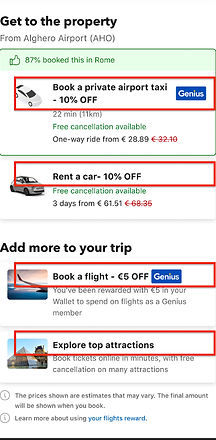

Base UI in English and Russian
Project Overview
Problem / Goals:
While conducting a comprehensive audit of the cross-sell experience on mobile, I identified key issues likely causing user friction and contributing to higher churn rates in the post-booking funnel.
One major problem was the cluttered UI, which increased cognitive load and made users hesitant to engage with the product.
To address this, we focused on optimising the interface to simplify the experience, reduce cognitive load, and encourage seamless exploration.
How I helped:
-
Conducted content audit
-
Facilitated brainstorming workshop
-
Optimised existing copy
-
Conducted A/B testing
How I worked on this project

An overview of how it went down - from ideation to implementation
What I Did
Content Audit
I began by conducting a comprehensive content audit against five criteria:
-
Clarity
-
Consistency
-
Conciseness
-
Relevance
-
Purposefulness
The audit revealed that the majority of existing vertical headers failed to meet the benchmarks for conciseness, consistency, and clarity.
These issues were especially pronounced in longer languages, where verbose headers disrupted the UI and narrative.
To align stakeholders, I summarised these findings in a detailed share-out document and presented it to UX and product teams.
This helped build consensus around the need for optimisation and set the stage for ideation.
Brainstorm Session
To address the audit’s findings, I organised a cross-functional brainstorming session with the product and design teams.
Among the ideas proposed, the design team hypothesised that introducing badges could reduce the amount of text in the headers while maintaining their functionality.
They launched an initial design experiment to test this solution, which achieved notable success and went full-on after a positive pilot.
Hypothesising Copy Improvements
Building on the momentum of the design experiment, I hypothesised that removing verbs from the headers would further enhance conciseness, clarity, and consistency.
Additionally, this adjustment would:
-
Reduce the cognitive load on users.
-
Create a less directive and pushy narrative.
-
Improve alignment across languages and verticals.
This hypothesis informed a focused copy experiment targeting key pages where we showed the cross-sell experience.

Findings from the audit

Ideas from brainstorm session with design and product
....And then

Improved UI with badges introduced
Copy Explorations
I started working on explorations with the goal of making the messaging as concise as possible without compromising clarity for users.
At the end of this exercise, I had whittled down the headers as follow:
-
Book a private airport taxi = Private airport taxi
-
Rent a car = Car rental
-
Book a flight = Flights
-
Explore top attractions = Attractions
Localisation
I worked with the localisation teams across 44 languages to translate these new versions of the headers in preparation for A/B testing.
A/B Testing
To validate my hypothesis, I ran an A/B test comparing the alternative header options (without the verbs) against the base versions.
Key Metrics Measured:
-
Conversion rates
-
Click-through rates
The variant headers performed exceedingly well and led to a significant increase in click-through rates (+15.78%) as well as conversion rates (+6.12%)
Hypothesis for the Outcome:
I believe the treatment worked due to the following factors:
-
Reduced Cognitive Load: Shorter, verb-free headers are easier to scan and process, aiding quick decision-making.
-
Aligned with User Context: Concise headers suit on-the-go, goal-oriented mobile users by minimising distractions.
-
Less Pushy Tone: Neutral messaging feels less directive, fostering comfort and user trust.
-
Improved Visual Design: Clean, uncluttered headers enhance readability and focus on key elements.
-
Localisation-Friendly: Simplified headers ensure consistent translations and prevent design breakage in longer languages.
-
Encourages Exploration: Non-committal headers invite users to explore without pressure, boosting engagement.
Results
The copy experiment achieved massive success, validating our hypothesis and leading to a +6.12% increase in transactions and a +15.78% increase in overall clicks.
What I learned
-
Shorter, cleaner headers improved usability for on-the-go users, aligning with their transactional mindset.
-
Reducing text clutter improved scannability and allowed for faster decision-making.
-
Removing verbs made headers feel less pushy, encouraging more users to explore options at their own pace.
By delivering concise, clear, and consistent headers, we achieved measurable improvements in user engagement and conversions, making a meaningful contribution to both the user experience and business outcomes.


Final UI with verbs removed + badges in EN and Russian
Expansion to web
Following the success of the mobile app experiment, I collaborated with the design team to iterate on this treatment for web.
We applied the combined design and copy adjustments to headers, resulting in another set of successful experiments that also went full-on on mobile web.
Check live product here.